 Safeguarding
 Find a church
 Find clergy

Fr Hywel Davies, a retired priest in Cynon Uchaf Ministry Area explains the tradition of Plygain as he looks forward to an upcoming event in Aberdare.
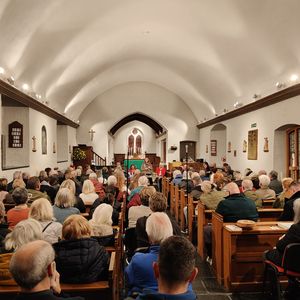
One of the spin-offs of the 2024 National Eisteddfod in Pontypridd was the large number of fund-raising events it occasioned. It will be the same when the National Eisteddfod visits Cardiff again in 2028. In the Cynon Valley one event from 2024 has established itself in the life of St Fagan`s church, Aberdare. On January 10th, 2027, the Sunday after Epiphany, we shall hold our fourth Plygain to date, at 5pm. Visitors attend the service from all across south Wales – some to take part, others, simply to take heed, and enjoy the proceedings.
The name ‘Plygain’ is a composite, formed from two Latin words, ‘pulli’ and ‘cantus’ - referring to the early morning song of the cockerel. Traditionally, the Plygain was held before the crack of dawn on Christmas day. It`s origins in Wales date to pre-Reformation times and the word is first recorded in the 13th century Black Book of Carmarthen - a collection of early Welsh manuscripts. According to custom, various families would ‘own’ particular Plygain carols, and guard them jealously. Since they were rarely committed to print, transmission from one generation to another depended on an oral tradition that made limited access possible.
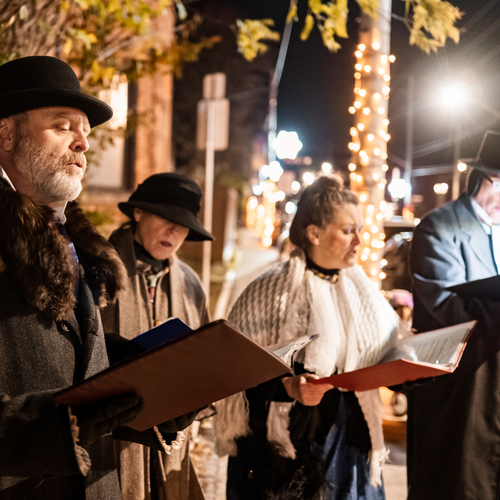
Perhaps the most notable difference to the carols (largely Victorian) we usually hear, is that the Plygain carols are all in Welsh. They`re also invariably sung unaccompanied, in three or four-part harmony. Also, the content is highly theological. Multiple verses trace the whole story of the salvation that is in Christ, from the Fall to his Second Coming. Moreover, Plygain singing has a wider window that is usual with popular English carols: Plygain services can be held at any time between Advent and Candlemas (February 2nd), and no longer necessarily by candlelight in the small hours!
To the casual observer, it might appear that a Plygain service is quite without structure. There is no set order of participants, nobody seemingly seems to be ‘in charge’, and there is no certainty as to who will actually turn up! But if there a few formalities, there are protocols in abundance.
Appropriately since the Plygain has its roots in church liturgy, the opening part of the service follows the order of ‘Y Gosber’ (Evensong), including a congregational hymn. This is important as a reminder to all present that the Plygain is not a concert or a ‘Noson Lawen’. No contributors – choirs, quartets, duets, solos – are applauded, but all are valued as an offering of praise and thanks.
Following the Collects for Evensong, the presiding cleric says the words of invitation: ‘Mae`r Plygain nawr ar agor’ (‘The Plygain is now open’). It is the privilege of the host church to open proceedings, but after that, it really is a matter of who makes it to the front first! Protocol demands that there be no unseemly rivalry – but once a particular carol has been sung once, no one else should repeat it. That would be bad form. So, getting ‘your’ carol in first becomes a matter of strategy.
Once the first Cycle of carols is exhausted, with no repeats and nobody contributing more than once, another congregational hymn is sung. The second Cycle follows the order established in the first half. Finally, and following the blessing, everybody who has contributed gathers in front of the altar to sing the traditional ‘Carol y Swper’. It heralds the welcoming supper to which all present are invited. Traditionally, it was the men only who gathered to sing ‘Carol y Swper’, while the women looked to the feast that awaited their menfolk. No way could we agree to such gender differentiation in Aberdare - so here, men and women join in singing the final Plygain carol together.
If you want to experience the Plygain, or, better still, if you want to take part, please join us at St Fagan`s Church, Trecynon, Aberdare, CF44 8LN, on January 10th 2027. The Plygain is a venerable Welsh Church tradition that deserves widespread support in our diocese. In recent years a number of collections of Welsh folk carols have been published, greatly aiding a renewal of interest in the Plygain. Perhaps the two most helpful for those wishing to learn more are: ‘Hen Garolau Plygain’ (edited: Arfon Gwilyn; 2006) and ‘Seiniwn Hosanna’ (ed. Arfon Gwilym; 2022)
For further information, please contact y Tad Hywel Davies, on 07799066945.