Passiontide Pilgrimage of Living Water
Congregations from across the Cynon Uchaf Ministry Area have come together for a remarkable Passiontide Pilgrimage, an event rooted in history, symbolism, and the shared life of a Christian family. The idea had been sparked months earlier when Fr Hywel Snook, Transition Minister, read an article listing the oldest buildings in each European country.
He later reflected, “I was taken aback when I realised that half of the buildings were built after 1189, when St John’s was built. It made me think of when I went to the US for work, and I went to the Capitol building in Madison. The guide said that Wisconsin was one of the older states, being founded in 1848. I said, ‘I think my junior school is a few years younger than that.’ The Americans were amazed, even more amazed when I told them about St John’s. We take all of this for granted in Wales as we are surrounded by the ancient and modern.”
That sense of deep heritage became the seed of the pilgrimage. Each congregation in the Ministry Area came from a different place, yet all ultimately traced their roots back to St John’s, and St John’s owes its roots to the Benedictine monks of Cardiff. The ruins of their monastery still lay quietly in Bute Park, near the castle, a reminder of the spiritual wellspring from which the valley’s churches grew.
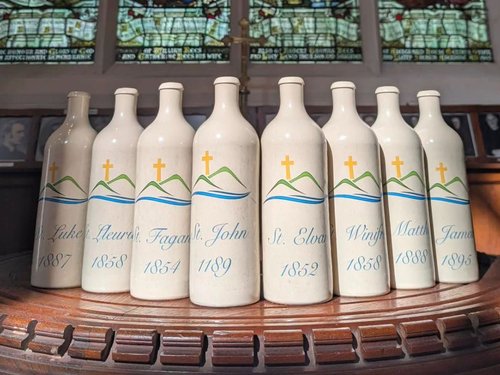
To help the Ministry Area reflect on the theme that everyone comes from somewhere else, and yet belongs to one family, Fr Hywel came up with the idea of the Passiontide Pilgrimage. He commissioned eight earthenware bottles, each painted with the Ministry Area logo and inscribed with the name and consecration date of one of the MA churches (St Elvan in Aberdare, Sant Fagan in Trecynon, Saint John the Baptist in Aberdare, Saint Matthew in Abernant, Saint James in Llwydcoed, Saint Luke in Cwmdare, Saint Lleurwg in Hirwaun and Saint Winifred in Penywaun). Fr Hywel travelled to Bute Park to fill the St John’s bottle from the stream running beside the old Benedictine ruins, carrying the symbolic water back to the church that became the heart of the Ministry Area.
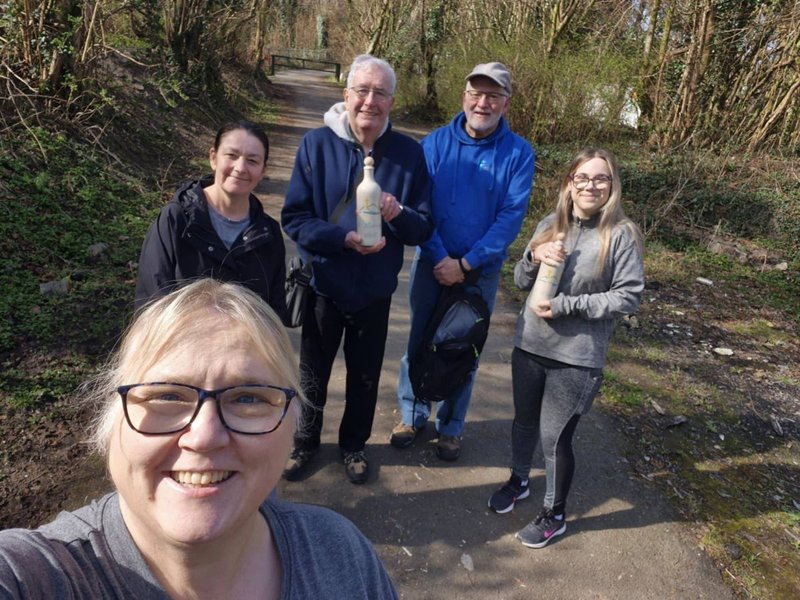
Members from each congregation were then invited to fill their own bottle with water from their church and walk together in pilgrimage to St John’s. Each group set off at a different time, converging at the church for tea, fellowship, and a short service. It was a gentle, visible expression of unity, many paths leading to one place, many stories flowing into one shared identity.
As the congregation sang Guide Me, O, Thou Great Redeemer', the bottles were placed on the high altar. The symbolism of eight congregations, guided by their redeemer to share a space at God's table was profound.
The pilgrimage echoed the words of Jesus: “Whoever believes in me, as Scripture has said, rivers of living water will flow from within them.” (John 7:38).
The pilgrimage embodied that image of people as living water, carrying their histories, hopes, and faith into a common stream.
Fr Hywel captured the spirit of the day with characteristic warmth and humour: “I wish we were able to run out of service sheets at all our services! We had so many people turn up we had to dig out hymn books that haven’t been used in over 30 years. What a fabulous problem to have!”
The journey will reach its culmination at the Easter Vigil when Fr Hywel will pour the water from all eight bottles into the font at St John’s. This mingled water will be blessed and used to renew the congregation’s baptismal promises, a powerful sign of a community coming together despite its differences and difficulties. One in Christ, making promises together.
In a valley shaped by ancient stones and living faith, the Ministry Area continued to discover that its strength lay not only in its history, but in its shared journey, many streams flowing into one living water.